Direct answer: For first graders and kindergarteners learning handwriting, the best primary composition notebooks blend wide ruled lines, dotted midlines, and space for drawings. These five picks support early writers with clearly marked lines, illustration space, and durable covers. They’re ideal for classroom use, homework, and journaling. The top choices include Mead’s classic primary books, a C-Line option, an Oxford two-pack, and a kid-friendly multi-pack from ONAVIA. Below is a quick buying guide and a comparison table to help you pick the right one for your student’s needs.
| Product | Best For | Notes |
|---|---|---|
| Mead Primary Composition Book, 09902 | Young learners needing clear primary ruling | Includes solid and dotted lines; 100 sheets |
| Mead Primary Journal Creative Story Tablet, 10297 | Story writers who illustrate | Top half blank; manuscript alphabet on cover |
| C-Line Primary Ruled, 22020 | Creative writing with built-in prompts | Top unruled area; red baseline and dotted midline |
| Oxford Primary Ruled Notebook, 1002521 | Structured handwriting practice | 2-pack; blue top line and dotted midline |
| ONAVIA Primary Composition Notebook, 4 Pack | Budget-friendly class sets | Unruled drawing space with primary ruled lines |
Mead Primary Composition Book, 09902
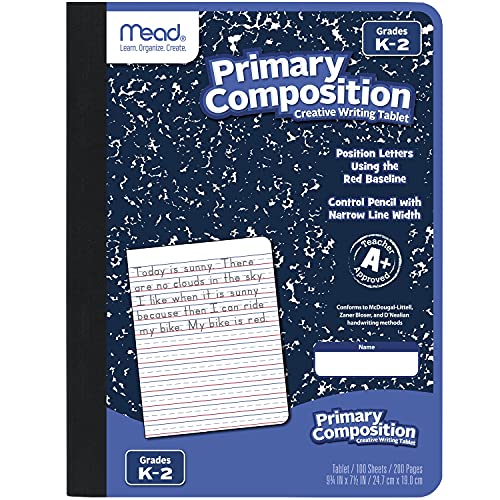
This book is ideal for grades K-2. It uses primary ruled paper with solid and dotted lines to guide letter sizing and spacing. The 100 double-sided sheets provide ample space for writing practice and quick journaling. Best for beginners who need structured lines and a durable, kid-friendly cover. A potential limitation is the single-color design, which may be less engaging for students who benefit from more visual variety.
Mead Primary Journal Creative Story Tablet, 10297

Best for K-2 students who want to combine handwriting with storytelling. It features 100 double-sided primary ruled pages and a blank top half for illustrations. The cover includes a manuscript alphabet for quick reference, helping early writers form letters and words. Choose this if you want a notebook that doubles as a creative journal. A caveat is that the focus on storytelling may not suit students who primarily require straight handwriting practice.
C-Line Primary Ruled Notebook, 22020

Best for beginners who benefit from a clear layout that blends drawing and writing. The top section is unruled for pictures, while the bottom includes a red baseline and dotted midline to guide letter placement. The inside front cover shows an alphabet and numbers, and the back cover explains storytelling basics. This notebook supports both handwriting and early storytelling. A potential limitation is the mixed layout which may require teaching prompts to maximize page use.
Oxford Primary Ruled Notebook, 1002521

This two-pack is designed for Pre-K through 2nd grade learners. It uses primary ruling with a dotted midline to help students form tall and small letters and descenders. The blue top line and the red baseline aid alignment and spacing. The covers are durable for daily use. Best for students who benefit from a structured, repeatable handwriting format and a sturdy, shared classroom resource. A limitation is the two-pack size may be more than needed for a single student.
ONAVIA Primary Composition Notebook K-2, 4 Pack

Best for bulk classroom use and home schooling, this 4-pack provides unruled top space for drawings and primary ruled lines below. It supports K-2 learners with a layout that emphasizes sentence-building and illustration. The pack format makes it easy to rotate notebooks among multiple students. A caveat is that some users may prefer more color variety or larger page counts for extended projects.
Buying Guide
- Layout and lines: Look for primary ruled pages with solid and dotted midlines to help letter sizing and spacing. Some notebooks offer unruled drawing space on top for illustrations, which can reinforce storytelling skills.
- Age and skill fit: For Kindergarten to 2nd grade, choose notebooks explicitly labeled K-2 with wide ruling to accommodate early handwriting development.
- Illustration space: If encouraging creativity, prefer notebooks with blank or lightly ruled illustration space, or a manuscript alphabet on the cover as a reference.
- Durability: Consider sewn binding and sturdy covers for frequent use in desks or backpacks. A durable cover reduces wear during ongoing practice.
- Volume and price: For classroom sets, multi-pack options are convenient and cost-effective. Ensure the sheet count aligns with your expected usage to avoid frequent replacements.
Frequently Asked Questions
- What is primary ruled paper? It features a solid line with a dotted midline to guide handwriting height and letter formation.
- Who should use these notebooks? They’re ideal for kindergarten through second grade students learning handwriting and basic storytelling.
- Why choose a notebook with drawing space? Drawing helps kids connect ideas to writing and strengthens fine motor skills.
- How many sheets are typical? Most primary composition notebooks in this category have 100 sheets (200 pages) per book, suitable for a full school year of practice.
- Are these good for journals? Yes, especially variants with blank or lightly ruled top sections that encourage daily writing and reflection.
- Should I buy in bulk? If you’re outfitting a classroom or homeschooling several children, bulk packs save time and money and ensure uniform supply.