Discover engaging activity books that blend handwriting practice, critical thinking, and early math skills. These top picks for kindergarten help children build confidence, fine motor skills, and school readiness through interactive, device-free activities. Below you’ll find five well-rounded options with kid-friendly designs and durable formats designed for repeated use.
| Product | Brand | Focus |
|---|---|---|
| Preschool Learning Activities | Momo & Nashi | Tracing, handwriting, motor skills |
| School Zone Thinking Skills Workbook | School Zone | Problem-solving, logic, reasoning |
| School Zone Connect the Dots Workbook | School Zone | Counting, number puzzles, fine motor work |
| Learning Resources Skill Builders! Kindergarten Flipbook Library | Learning Resources | Spelling, counting, sight words |
| Preschool Learning Activities Kindergarten Workbooks | Walenty | Tracing, handwriting, coloring, shape and number work |
Preschool Learning Activities – Tracing Books
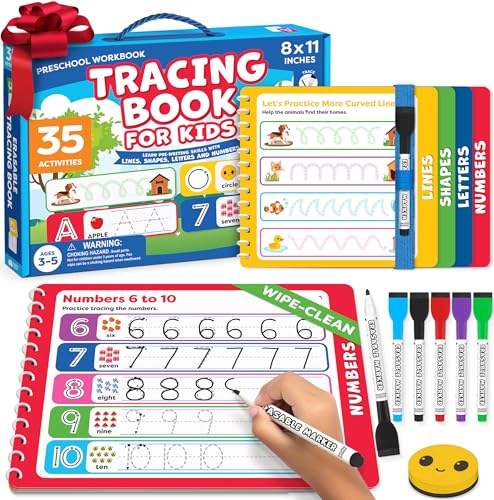
These all-in-one tracing books are designed for kids ages 3-5, blending handwriting practice with engaging activities. The set includes six colorful markers, a smiley eraser, and a sturdy storage box, promoting independent play without extra tools. The dry-erase format supports repeated practice, making it ideal for homeschool settings or classrooms. Activities focus on letter tracing, shapes, lines, and numbers from 1 to 10, helping young learners build stroke recognition, color sorting, memory, and coordination—foundational skills for early writing and school readiness.
The kit emphasizes non-toxic, reusable use with included dry-erase pens and accessories. It’s positioned as a versatile resource for developing dexterity, pencil grip, and focus. Parents can rotate activities to sustain attention and encourage consistent practice, whether at home or in a daycare or Montessori environment. The materials are designed to be ADHD-friendly, supporting independent exploration and gradual skill-building while reducing screen time.
School Zone Thinking Skills Workbook

This 64-page workbook targets preschoolers and kindergartners with problem-solving, logic, and reasoning puzzles. It’s designed to boost critical thinking in early learners through age-appropriate activities that align with Get Ready! book series standards. The workbook format supports progressive skill-building, helping children transition to more advanced tasks as they gain confidence. Parents and educators can use the activities to assess early cognitive development, spatial reasoning, and pattern recognition, providing a structured path toward classroom readiness.
School Zone Connect the Dots Workbook

Designed for ages 3 to 5, this dot-to-dots workbook combines tracing, counting, and coloring activities to reinforce fine motor skills and number sense. The book’s simple layouts help children practice steady hand movements while building confidence in completing tasks. It also reinforces early math concepts by guiding young learners through orderly sequences, which supports number recognition and sequencing ability—crucial components of kindergarten readiness. The compact workbook format makes it easy to tuck into backpacks for on-the-go practice.
Learning Resources Skill Builders! Kindergarten Flipbook Library

Three spiral-bound flipbooks form a compact library that targets kindergarten-ready skills. Each flipbook focuses on a distinct domain: counting by tens, sight words, and 3-letter CVC word spelling. The flipbook design encourages repeated, self-paced practice, making it suitable for independent learning and classroom centers. This kit helps children build foundational literacy and numeracy skills while fostering a habit of daily reading and writing. The modular format allows educators and parents to customize lessons and track progress across multiple skill areas.
Preschool Learning Activities Kindergarten Workbooks

This Walenty workbook set offers 52 activity pages designed to strengthen tracing, handwriting, coloring, and basic math concepts. Activities include letter tracing, number practice, color and shape recognition, matching games, sorting tasks, and spot-the-difference challenges. The durable hardcover design supports repeated use, with easy-erase capabilities via included markers and a whiteboard eraser. The book aims to foster attention, concentration, and independent learning, making it well-suited for homeschooling, daycare centers, or Montessori-inspired settings. It emphasizes steady skill progression and a broad range of practice to hold a child’s interest.
Buying Guide: Key Purchase Considerations For Kindergarten Activity Books
- Skill coverage: Look for a balanced mix of handwriting, counting, shapes, logic, and early literacy to support a well-rounded foundation for kindergarten.
- Durability and reuse: Books with wipe-clean pages or durable covers are ideal for prolonged use, reducing waste and cost over time.
- Age appropriateness: Choose activities labeled for ages 3-5 or 4-6 to align with typical kindergarten readiness milestones.
- Format and accessibility: Consider thumb-friendly formats like spiral flipbooks or dry-erase workbooks for easy handling and self-guided practice.
- Independence support: Activities should allow kids to work with minimal adult instruction to build confidence and routine.
- School alignment: If possible, select materials that reinforce early writing, number sense, and basic problem-solving commonly used in classrooms.
- Non-toxicity and safety: Ensure materials are kid-safe, non-toxic, and appropriate for repeated handling by young children.
- Supplemental tools: Some sets include markers, erasers, or storage boxes; these extras can improve usability but are not essential.
- Space and portability: Compact options work well for travel or small study spaces without sacrificing content variety.
- Progress tracking: Look for features that let caregivers monitor improvement across tracing, letter formation, and counting skills.
In evaluating these options, consider your child’s current skill level, attention span, and learning environment. For a comprehensive approach, combine tracing and handwriting practice with activities that cultivate cognitive skills like problem-solving and sequencing. The right mix can help kindergarten learners build confidence, sustain curiosity, and establish a solid academic routine as they prepare for first grade.