Libraries need reliable, high-quality book scanners that can handle thick volumes, fragile pages, and diverse languages. The following selections are among the best options for library use, offering fast optical scanning, intelligent flattening, multilingual OCR, and compatibility with Windows, macOS, and Linux where noted. Each product is chosen for durability, ease of integration into a library workflow, and the ability to produce searchable, editable digital copies for cataloging and access.
| Product | Brand | Key Advantage |
|---|---|---|
| Aura Pro Book & Document Scanner | CZUR | AI-powered processing, foldable design, fast two-second pages |
| ET24 Pro Professional Book Scanner | CZUR | Advanced 24MP camera, 3rd-gen auto-flatten |
| Aura Pro Portable Book Scanner | CZUR | Compact, foldable, multi-language OCR |
| Shine Ultra Smart Portable Document Scanner | CZUR | Ultra-fast A3 scanning, document camera functions |
| Shine Ultra Pro 24MP Document Scanner | CZUR | High-resolution, curve-flattening for large formats |
Note: All models listed offer JPG, PDF, and searchable PDF outputs, with OCR support in multiple languages. They’re designed to minimize page curl and glare while delivering accurate reproductions suitable for cataloging, preservation, and public access stations.
Aura Pro Book & Document Scanner

The Aura Pro combines Auto-Flatten and Deskew technologies with foldable portability. It is designed to deliver glare-free scans with a 2-second per page speed. Output formats include JPG, Word, PDF, and searchable PDF. The scanner is powered by CZUR APP software and requires no WiFi or Bluetooth, strengthening library security and workflow reliability. It supports macOS and Windows with broad compatibility and offers 4 color temperature settings to adapt to various page finishes.
ET24 Pro Professional Book Scanner
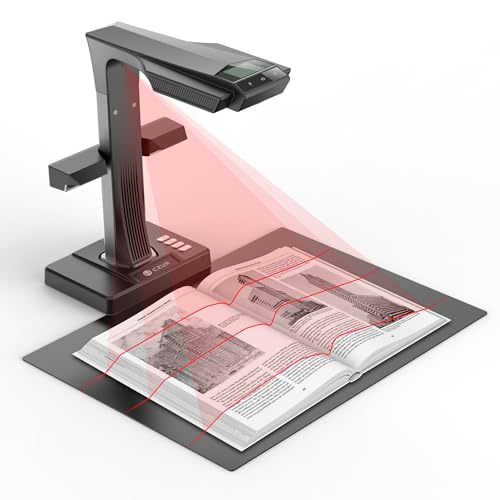
The ET24 Pro features a 24MP HD camera with 320 DPI and 5696×4272 resolution for high-detail captures. Its flattening technology flattens curved pages after pixel transformation, improving legibility. It supports macOS 10.13+, Windows, and Linux variants, making it flexible for mixed-OS library environments. The device emphasizes robust OCR readiness and broad language support, though it notes some languages like Thai, Arabic, and Hebrew may have limitations. It’s suitable for A3 documents and bound books with careful handling.
Aura Pro Portable Book Scanner

This portable model emphasizes three-laser line flattening for precise capture of curved pages, offering intelligent AI-driven software workflows. It supports macOS and Windows, with a scan speed of about 2 seconds per page for single and double-page spreads. The device includes supplemental side lights to reduce reflections on glossy pages, auto-detects page turns, and can be controlled via a foot pedal for hands-free operation. It supports a wide range of formats and languages through its OCR capabilities.
Shine Ultra Smart Portable Document Scanner

The Shine Ultra Smart is designed for A3 and A4 documents, delivering ultra-fast scanning speeds and broad OS compatibility (Windows and macOS). It also functions as a document camera suitable for remote teaching and meetings, integrating with platforms like Zoom and Google Meet. It supports JPG, PDF, searchable PDF, Word, and Excel OCR outputs, with CZUR’s patented flattening technology to manage curved pages. It’s optimized for flat paper scanning with strong performance for public access desks and library programming.
Shine Ultra Pro 24MP Document Scanner
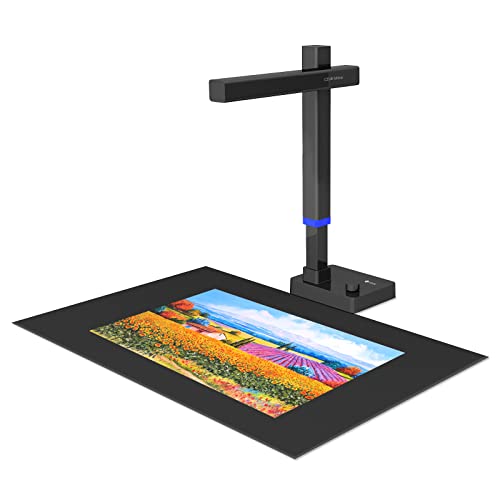
The Shine Ultra Pro 24MP offers high-resolution scanning with a 24MP CMOS sensor and up to 5696×4272 resolution. It uses curve-flattening technology to produce distortion-free digital copies of bound pages and supports 180+ languages through OCR. Outputs include JPG, PDF, and searchable PDF with Word and Excel formats as options. While suitable for large-format scanning (A3), it notes that glossy materials may require careful handling to avoid glare. This model is ideal for comprehensive library digitization projects requiring clarity and accuracy.
Buying Guide for Library Book Scanners
When selecting a book scanner for a library, consider these factors to match your workflow and budget:
- Page handling and flattening: Look for dynamic flattening technology to reduce distortion on curved pages, especially for bound volumes. Consider models with auto deskew and auto page-turn features to streamline batch scanning.
- Resolution and OCR: High-resolution sensors (at least 24MP on professional models) enable clearer scans and more accurate OCR across languages. Confirm supported output formats (JPG, PDF, Searchable PDF, Word, Excel).
- Language support: If the library serves multilingual patrons, ensure OCR supports multiple languages and that fonts are accurately recognized. Some models exclude specific scripts; verify coverage for your needs.
- Compatibility: Check operating systems in use (Windows, macOS, Linux) and any required software. Some devices work standalone, while others rely on companion apps for processing.
- Size and durability: For desk space and heavy use, choose models engineered for durability or foldable/portable forms for room flexibility. Ensure consistent scanning speeds for long sessions.
- Security and network: Consider offline operation to prevent network exposure and ensure digitization workflows comply with records management policies. USB-only devices reduce wireless transmission risk.
- Workflow integration: Look for features like auto-detection, foot pedal control, and batch export capabilities that align with library cataloging, digital preservation, and accessibility initiatives.
- Cost of ownership: Evaluate long-term maintenance, software updates, and availability of replacement parts. While high-end models offer superior performance, assess total cost against expected digitization volume.
Libraries may implement a mixed setup, combining portable scanners for quick outreach and high-end models for archive projects. Image quality, OCR accuracy, and reliable flattening are essential to ensure digital copies are useful for patrons and staff alike. All listed CZUR models provide robust features for library digitization, balancing speed with accuracy and ease of use.