Libraries require reliable, high-volume scanning solutions that preserve book integrity while delivering crisp digital copies. The following five book scanners combine flattening technology, fast speeds, broad language support, and robust OCR to help librarians digitize collections, automate cataloging, or enable remote access. Each model is designed to handle bound volumes with minimal page damage and offer cross‑platform compatibility for Windows, macOS, and Linux where noted.
| Model | Brand | Key Feature | OCR Languages |
|---|---|---|---|
| CZUR ET24 Pro | CZUR | 3D page flattening, 24MP camera, A3 capture | 180+ languages |
| CZUR ET MAX Professional | CZUR | 38MP sensor, curve-flattening, high fidelity | 180+ languages |
| CZUR Aura Pro | CZUR | AI-assisted flattening, foldable, quick 2s per page | 180+ languages |
| CZUR Aura Pro Portable | CZUR | Laser page flattening, AI processing, foldable | 180+ languages |
| CZUR Shine Ultra | CZUR | Thin, portable, 2s/page, multi-format output | 180+ languages |
Note: All models listed support common document formats and OCR output. Some features vary by operating system and paper type; consult product specs for detailed compatibility and recommended usage in library environments.
CZUR ET24 Pro Professional Book Scanner
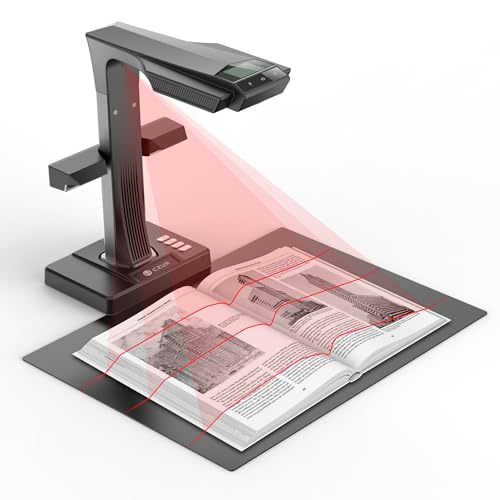
The ET24 Pro employs CZUR’s flattening technology to correct 3D curved book pages after pixel transformation. It features a 24MP HD camera with 320 DPI and 5696×4272 resolution, enabling detailed digital copies. Compatibility spans macOS, Windows, and Linux, making it suitable for diverse library tech environments. This model is particularly effective for standard-format libraries, where glare is minimized with careful paper selection and lighting adjustments. OCR supports 180+ languages for searchable, editable outputs.
CZUR ET MAX Professional Book Scanner

The ET MAX elevates image fidelity with a 38MP CMOS sensor, delivering up to 7168×5376 resolution at 410 DPI. Its patented curve-flattening technology instantly removes page distortion, reducing manual intervention. OCR converts scans into editable Word, Excel, and searchable PDFs across 180+ languages. While highly capable, users should note OCR limitations for Thai, Arabic, and Hebrew in this configuration, and ensure drivers and software are kept up to date on all library workstations.
CZUR Aura Pro Book & Document Scanner

The Aura Pro combines auto-flattening with AI-powered processing and a foldable form factor for compact storage. It scans A3 and A4 pages quickly—about two seconds per page—and stores outputs in JPG, Word, PDF, or searchable PDF formats. The unit supports macOS and Windows, with glare-free operation aided by a smart lamp. CZUR’s app provides page-turn detection and an optional foot pedal for hands-free operation, ideal for routine library digitization workflows.
CZUR Aura Pro Portable Book Scanner

The Aura Pro Portable emphasizes foldability and AI-enhanced processing while delivering rapid scans at 2 seconds per page for single or double-page spreads. It is compatible with Windows and macOS, and supports multiple output formats including searchable PDF and Word. The device aims to balance portability with robust capture quality, making it suitable for satellite libraries, branch locations, or temporary digitization projects where space is at a premium.
CZUR Shine Ultra Smart Portable Scanner

The Shine Ultra is a thin, high-speed document camera capable of capturing A3 and A4 documents with OCR support across 180+ languages. It emphasizes fast performance—about 1 second per page—with a compact footprint that’s ideal for small libraries or on-demand digitization stations. It works with Windows and macOS and is designed for flat paper scanning and integration with common office software via PDF, Word, and Excel formats.
Buying Guide
Key considerations when selecting a library scanner:
- Page Flattening Technology: Look for devices that automatically flatten curved book pages to minimize distortion and reduce manual deskewing. This is critical for bound volumes and archival materials.
- Resolution And OCR Quality: Higher megapixels and optical resolution yield crisper scans. Check supported OCR languages; libraries with multilingual collections benefit from broad language support and reliable text extraction.
- Speed And Throughput: Consider pages per minute and per-page processing time. For busy libraries, models offering 2-second pages or faster can substantially increase daily digitization capacity.
- Software Ecosystem: Assess the bundled software for image processing, automatic page detection, file formats, and OCR accuracy. App integrations and automation features can streamline workflows.
- Compatibility: Ensure operating system support matches your library’s workstations and any Linux environments used for digital repositories. Some models are Windows/macOS only, while others extend to Linux.
- Portability vs. Stationary Use: For branch libraries or space-constrained environments, portable scanners with foldable designs can be advantageous. For central digitization labs, larger, higher-resolution models may be preferred.
- Durability And Warranty: Library equipment endures frequent use; select units with durable construction and solid warranty terms.
- Output Formats: Prefer devices that offer searchable PDF, Word, and standard image formats, along with robust metadata capture to support cataloging systems.
When planning a library digitization project, it is beneficial to pilot one or two scanners to evaluate performance with your specific materials—particularly for older, glossy, or fragile bindings. Consider also staff training needs, workflow automation options, and long-term maintenance when building a scanning program.