Choosing the right 1st grade curriculum for homeschooling involves balancing foundational math, reading, and language skills with engaging activities that keep young learners motivated. This guide highlights five well-rounded options and provides a buying guide to help parents compare features, storage solutions, and classroom-ready materials. All selections emphasize hands-on learning, portability, and clear skill-building that aligns with early elementary standards.
Summary Of Chosen Products
- Skill Builders! 1st Grade Addition & Subtraction — Learning Resources — 109 pieces with built-in storage
- Skill Builders! 1st Grade Geometry — Learning Resources — 128 pieces with built-in storage
- Skill Builders! 1st Grade Reading — Learning Resources — 88 pieces with built-in storage
- Horizons 1st Grade Complete Set — Alpha Omega Publications
- Language Fundamentals, Grade 1 — Evan-Moor Educational Publishers
Skill Builders! 1st Grade Addition & Subtraction
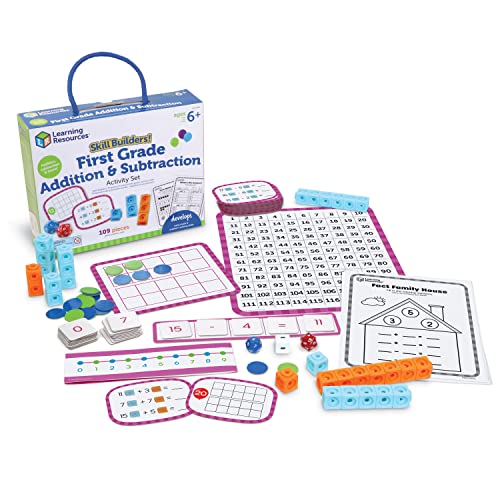
Designed to escalate early numeracy through hands-on tasks, this set helps first graders practice addition and subtraction with engaging materials. Students explore fact families, develop fluency with equations, and reinforce essential math concepts using MathLink Cubes, ten frames, and other manipulatives. The included carrying case supports organization and learning on the go, making it ideal for homeschool routines or travel between learning spaces.
Key features include classroom-ready math skills, a variety of activities that combine play with practice, and built-in storage to keep everything neatly contained after sessions. This kit supports foundational addition and subtraction pathways while encouraging independent work and collaborative play. It’s suitable for expanding math centers at home and providing a structured way to review core 1st grade concepts.
Skill Builders! 1st Grade Geometry

This geometry-focused kit introduces early spatial reasoning and shape concepts through hands-on activities. Children explore 2-D and 3-D shapes, symmetry, and basic geometry vocabulary through kid-friendly tasks and games. The included set’s storage case helps organize materials for easy cleanup and portability, supporting both structured lessons and exploratory play.
With a blend of shapes, fractions, and more, learners build geometric thinking alongside foundational math fluency. The hands-on format is designed to keep young learners engaged while reinforcing critical early math competencies. For homeschool families wanting to integrate geometry alongside broader math curricula, this kit provides practical activities that complement daily math practice.
Skill Builders! 1st Grade Reading

This reading-focused kit emphasizes classroom-ready language development through interactive activities. Children practice phonics, word blends, and essential reading skills in engaging formats designed for 1st grade readers. A built-in storage solution keeps reading components organized for quick setup and tidy after-session cleanup, which supports consistent daily practice and routine building in homeschool settings.
The program covers long and short vowels, high-frequency words, and foundational grammar concepts. Its hands-on approach encourages experimentation with sound-spelling relationships while reinforcing reading fluency and comprehension. The materials are well-suited for both literacy centers and one-on-one instruction, helping parents tailor pace to each child’s needs.
Horizons 1st Grade Complete Set

Horizons offers a complete 1st grade curriculum set that emphasizes a balanced approach to core subjects. This option typically includes structured lessons, reading, math, and additional activities geared toward foundational skills. The complete set is designed to provide a coherent pathway through the school year, with resources intended for steady progression and consistency in daily instruction.
Users should evaluate how Horizons aligns with preferred pacing, whether the material supports daily lesson plans, and how well it integrates with supplementary activities such as hands-on projects or optional assessments. The program’s adaptability can be a benefit for families seeking a comprehensive, all-in-one framework that complements other homeschool resources.
Language Fundamentals, Grade 1

This language arts resource centers on essential language fundamentals for first grade. It covers language skills, grammar practice, and writing foundations in a structured format. The materials are designed to support learners as they develop basic sentence construction, punctuation awareness, and vocabulary growth, which are critical building blocks for reading and writing proficiency in early elementary grades.
Parents can use this resource to complement reading programs, add targeted grammar practice, and provide additional writing opportunities. Its straightforward approach makes it suitable for daily practice, tutoring sessions, or as a supplemental spine within a broader language arts plan.
Buying Guide: Key Purchase Considerations For 1st Grade Homeschool Curricula
When evaluating 1st grade curricula, several dimensions help determine the best fit for a family’s goals and learning environment. The following considerations present multiple perspectives to ensure a well-rounded choice:
- Scope and balance: Look for a mix of math, reading, and language arts to avoid gaps. Programs that blend hands-on activities with printables and digital components can accommodate varied learning styles and pacing.
- Hands-on vs. worksheets: Hands-on kits support fine motor skills and tangible understanding, while structured worksheets can reinforce practice. A hybrid approach often works best for many households.
- Storage and portability: Built-in storage or carrying cases simplify organization and on-the-go learning. Portability is especially helpful for families that move between homes or frequently travel.
- Adaptability and pacing: Some curricula offer flexible pacing or modular components, allowing parents to tailor the intensity to the child’s needs. This is valuable for students who grasp concepts quickly or require extra time on challenging topics.
- Assessment and progression: Check whether the program includes progress tracking, checklists, or suggested benchmarks. Regular feedback supports monitoring development and adjusting instruction.
- Longevity and future alignment: Consider whether the material provides a smooth transition to subsequent grades and aligns with commonly used standards in the United States, such as core math and language arts competencies.
- Cost and value: Compare the per-year cost, including consumables and replacement parts, and weigh it against the breadth of activities, manipulatives, and the overall learning experience.
- Support and community: Access to teacher guides, customer support, and online communities can aid parents who are new to homeschooling or exploring a new curriculum framework.
- Age appropriateness: Ensure materials are designed for the 6+ age range typical of 1st grade while offering enough challenge to promote growth without causing frustration.
Putting it all together, a strategic choice often combines a robust math kit, a structured reading program, and a language fundamentals resource to cover core competencies. Selection can depend on whether families prioritize consolidated all-in-one sets or prefer a curated mix of individual components from reputable publishers. Evaluating sample lessons or trials where available can also clarify how well the materials fit a student’s learning style and daily schedule.