Finding the right math books for 6th grade can boost understanding of fractions, decimals, equations, and basic data analysis. The following picks cover essential topics aligned with standards, offer practice and assessments, and suit classroom or homeschool use. Each entry includes key features to help you compare how well they meet your student’s needs.
| Product | Brand | Key Focus |
|---|---|---|
| Spectrum 6th Grade Math Workbooks | Spectrum | Fractions, decimals, equations, percents, probability |
| Spectrum Grades 6-8 Algebra 1 Workbook | Carson Dellosa Education | Algebraic equations, rational numbers, functions, graphing |
| Shell Education 180 Days of Problem Solving for Sixth Grade | Shell Education | Daily problem-solving practice |
| Horizons 6th Grade Math Student Book 1 | Alpha Omega Publications | Parent-led curriculum, spiral learning, Christian approach |
Note: This summary highlights the most relevant options from the provided list. Each selection balances practice with conceptual development, making them suitable for a 6th-grade math routine at home or in a classroom setting.
Spectrum 6th Grade Math Workbooks
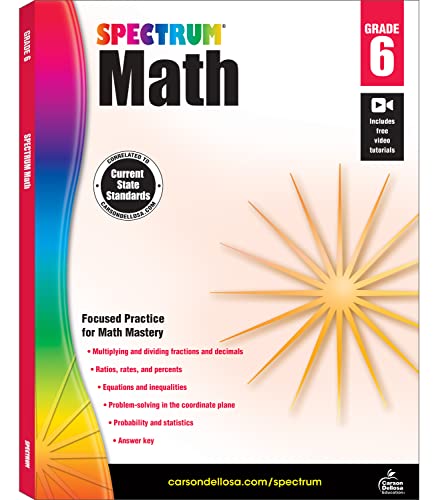
The Spectrum 6th Grade Math Workbooks provide a standards-aligned resource designed to bolster understanding across key topics. The program features a progression from simpler to more complex material, with chapter pretests, post-tests, mid-tests, and final tests to monitor growth. This structure supports steady skill-building in fractions, decimals, math operations, percents, probability, and statistics, making it well-suited for both remediation and enrichment.
Key considerations include alignment with current state standards and a clear testing framework that can guide progress checks. The workbook format also supports independent work and structured practice, which can be valuable for both classroom and homeschool environments. As with any workbook-based approach, pairing with hands-on activities and real-life math scenarios can help reinforce concepts.
Spectrum Grades 6-8 Algebra 1 Workbook
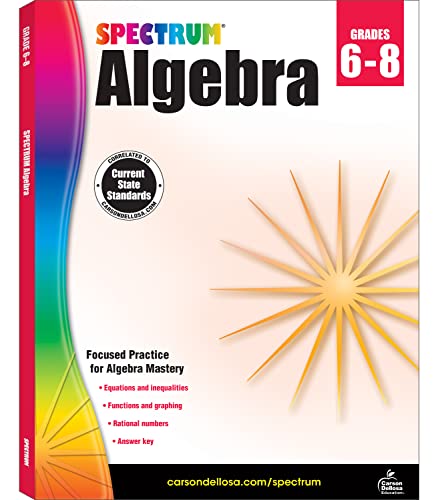
This Algebra 1 workbook from Spectrum extends beyond 6th-grade basics to introduce foundational algebra concepts. Topics include factors and fractions, equalities and inequalities, functions, graphing, and proportions, with activities designed to build problem-solving and analytical skills. It serves as a strong supplement for students transitioning to more formal algebra and can dovetail with standard math curricula in middle school.
Consider using this workbook as a bridge between arithmetic routines and algebraic thinking. It’s suitable for independent practice, classwork support, or tutoring sessions. The structure typically emphasizes clear instructions and progressively challenging problems, helping students solidify understanding while staying engaged.
Shell Education 180 Days of Problem Solving for Sixth Grade

Shell Education’s 180 Days of Problem Solving for Sixth Grade provides a consistent, day-by-day problem-solving routine. While described as a classroom resource, it can be used by motivated students at home for sustained practice. The emphasis is on applying mathematical reasoning to a broad range of problems, helping build logical thinking and perseverance.
The program’s approach is well-suited for teachers looking to structure daily problem-solving while giving students exposure to multiple mathematical contexts. Parents supporting independent learners may find the daily format helps establish a steady study habit. The materials are designed to be practical and accessible, with activities that reinforce core sixth-grade math concepts.
Horizons 6th Grade Math Student Book 1

Horizons 6th Grade Math Student Book 1 offers a parent-led curriculum with a focus on spiraling concepts. This approach can reinforce core skills while revisiting earlier topics to support mastery. The Christian-oriented curriculum may appeal to families seeking a faith-based framework, and the spiral structure helps students repeatedly encounter essential concepts with increasing depth.
Key considerations for families include alignment with values and instructional style, as well as the balance between guided instruction and independent practice. This option can pair well with daily math routines and can be used alongside other resources to provide a well-rounded mathematical experience for sixth graders.
Buying Guide: Key Purchase Considerations for 6th Grade Math Books
- Curriculum alignment: Check state standards and ensure the book covers fractions, decimals, basic operations, percentages, data interpretation, and introductory algebraic ideas.
- Practice density: Consider whether you need lots of short exercises, longer problem sets, or a mix of both to sustain engagement and reinforce learning.
- Assessment support: Look for chapters, pretests, post-tests, mid-tests, or end-of-unit assessments to track progress over time.
- Student level and pace: Some books are chapter-based with gradual increases in difficulty, while others follow a daily problem-solving format. Match to your student’s pace and readiness.
- Learning style compatibility: If you prefer a Christian or secular approach, choose accordingly. Some resources emphasize conceptual understanding, others focus on procedural fluency or algebraic thinking.
- Teacher or parent guidance: Resources with clear instructions, solutions, and step-by-step explanations can reduce frustration and improve independent work.
- Supplementary tools: Consider whether you want a companion workbook, online resources, or printable activities to complement hands-on learning.
- Durability and format: Spiral-bound or hardcover formats can withstand daily use; consider whether a printable format would better suit your setup.
Overall, the best choice depends on your student’s current level, learning preferences, and how you plan to structure practice. Combining one or two workbooks with daily problem solving and occasional assessments can provide a balanced approach that supports steady progress in 6th-grade math.