Exploring the solar system can spark curiosity and science literacy for young learners. The following five toys offer hands-on ways to learn about planets, stars, and space concepts, while staying engaging and age-appropriate. This guide highlights features, and how each product can support STEM play at home or in the classroom.
Product Snapshot
| Product | Brand | Key Benefit | Age Range | Link |
|---|---|---|---|---|
| Science Can Solar System Projector | Science Can | Interactive projector with 24 slides and bilingual audio | 5-7+ | View |
| National Geographic Glow-in-The-Dark Kit | Blue Marble | 3D glowing model with movable arms | 8-12 | View |
| Dan&Darci Inflatable Solar System | Dan&Darci | Large inflatables with hanging kits and learning cards | 5-12 | View |
| 64 PCS Solar System Project Kit | wookidel | Comprehensive DIY kit with art supplies | 3-5 | View |
| Zeoddler Wooden Solar System Puzzle | Zeoddler | Wooden planets puzzle for tactile learning | 3-6 | View |
Each pick emphasizes hands-on exploration, visual learning, and safe materials for kids. The list includes a mix of projector toys, 3D models, inflatables, craft kits, and wooden puzzles to suit different learning styles and play environments.
Science Can Solar System Projector with 8 Planets

Science Can’s talking solar system model offers a ceiling projection feature that transforms a room into a planetarium. The projector displays the eight planets orbiting the sun on walls or ceilings, turning playtime into a space exploration journey. The toy includes bilingual audio options in English and Spanish, helping kids build language and science vocabulary while learning about planetary order. Three disks provide 24 full-color space slides, including images of planets, spaceships, and astronauts, enabling a guided exploration of the solar system. The base lets kids press planetary patterns to receive educational facts, reinforcing learning through interactive prompts.
National Geographic Glow-in-The-Dark Solar System Kit

This all-inclusive kit helps kids build a glowing, movable solar system. The set includes six vibrant paints, glow-in-the-dark accents, brushes, decals, and a poster with solar system facts. The assembled model features movable arms, allowing children to adjust the planets’ positions and re-create the solar layout. The glow-in-the-dark finish adds a dramatic, visual element that keeps the model engaging even after lights are off, making it ideal for bedrooms or science corners in classrooms.
Dan&Darci Inflatable Solar System with Cards
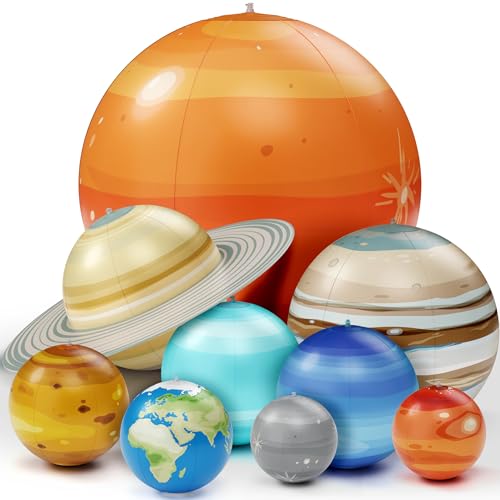
Dan&Darci offers jumbo inflatable planets and the sun, designed for ceiling hanging and immersive space decor. The set comes with galaxy-learning cards packed with key facts and vivid imagery, enabling interactive learning beyond mere display. Each inflatable has a built-in hanging loop for easy setup, so kids can arrange or orbit the planets around a room. This tactile approach to astronomy turns a ceiling display into a learning arena, encouraging experimentation with scale, orientation, and scientific storytelling.
64 PCS Solar System Project Kit

This project kit provides a hands-on crafting experience with foam discs for the sun, 12 foam balls, bamboo sticks, flags, brushes, paints, and an instruction guide. The kit supports collaborative learning through color mixing and construction of a personalized solar system. The included teaching content introduces planetary details, encouraging curiosity about astronomy while building fine motor skills and project planning. The durable polystyrene material is designed for repeated use in classrooms or home science stations.
Zeoddler Wooden Solar System Puzzle

Zeoddler’s wooden solar system puzzle uses natural wood pieces and planet-themed imagery, designed for ages 3-6. This tactile puzzle supports color recognition, hand-eye coordination, and problem-solving as kids fit planets in their correct order. The sturdy, portable format makes it a friendly option for car rides or classroom centers, where kids can practice sequencing while developing spatial awareness. The wooden construction offers a durable, child-safe option that complements other space-themed activities in a learning space.
Buying Guide: Key Considerations for Kids’ Solar System Toys
- Age appropriateness: Choose toys aligned with the child’s developmental stage. Younger kids benefit from large, tactile pieces and bright visuals, while older kids may enjoy more complex models and interactivity.
- Learning modality: Consider whether your child learns best through art, hands-on building, or interactive projection. A mix of crafts, models, and digital components covers multiple learning styles.
- Durability and materials: Wooden puzzles and foam crafts tend to endure more playtime and travel. Check for non-toxic paints, safe glues, and sturdy construction, especially for younger children.
- Storage and setup: Some kits require walls or ceilings to suspend, while others are tabletop or wall-mounted. Assess your space and the ease of setup and cleanup.
- Educational value: Look for clear planetary information, accuracy of scale references, and engaging prompts or cards that reinforce science facts beyond just visuals.
- Storage and portability: For travel or classrooms, lightweight inflatables or compact kits can be practical, while larger ceiling-hung sets may be better for home use.
- Multisensory features: Projects with colors, lights, and sounds tend to improve retention. Consider whether audio narration, glow effects, or rotating projections align with your goals.
- Future expansion: If you anticipate expanding the space learning theme, choose modular kits that can be added to over time without redundancy.
Across these options, parents and educators can tailor space-learning experiences to fit individual preferences—visual projection, hands-on modeling, or tactile puzzles—while building foundational science concepts about the solar system. Each product serves as a gateway to exploring planets, orbits, and astronomy in a structured, engaging way.