Finding the right primary lined composition book helps young students develop neat handwriting and clear storytelling. This guide highlights top options suited for kindergartners to second graders, focusing on durable bindings, clear primary rules, and kid-friendly formats. Each pick is explained with who it’s best for and why, along with practical cautions. For quick comparison, a summary table of the chosen products is provided below.
| Product | Best For | Why It Stands Out |
|---|---|---|
| Mead Primary Composition Book (09902) | Early writers and daily journaling | Classic primary ruling with solid and dotted lines to guide letter formation |
| Mead Primary Journal Creative Story Tablet (10297) | Story-focused writing | Top half blank for illustrations; manuscript alphabet reference on cover |
| C-Line Primary Ruled Notebook (22020) | Structured writing with drawing | Top unruled area for pictures; bottom primary lines with red baseline |
| Rosmonde 5 Pack Primary Composition Notebooks | Classroom sets or family use | Thick paper, sewn binding, primary lines for consistent writing |
| Oxford Primary Ruled Notebooks (2 Pack, 1002521) | Beginner handwriters | Durable covers; blue top line and dotted midline with red baseline |
Mead Primary Composition Book, 09902
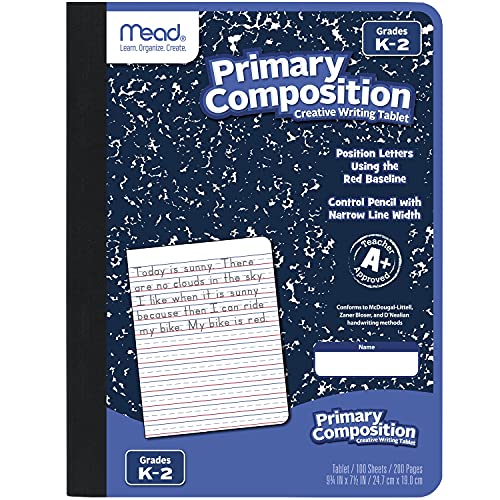
Best for: Young students who need clear visual guides for letter formation. The book uses primary ruled lines with solid and dotted strokes to help beginners align letters and maintain consistent spacing. The 100 double-sided sheets provide ample practice without frequent page turning. Choose this if you want a straightforward, classroom-friendly option with durable construction.
Why selected: This Mead edition is a staple for early handwriting practice, featuring age-appropriate ruling and a sturdy design that resists frequent use. Limitations: Some users may prefer additional illustration space on each page beyond the provided lines.
Mead Primary Journal Creative Story Tablet (10297)

Best for: Early writers who want to illustrate stories as they write. The top half of each page is blank for drawings, while the bottom half features primary lines to support readable handwriting. A manuscript alphabet reference on the cover assists with spelling and letter recognition. Use this if you want a narrative-focused notebook that integrates art and writing.
Why selected: It combines a kid-friendly layout with a writing-focused page design, making it a fit for story development. Caution: The page layout may be less suited for pure note-taking or non-creative writing.
C-Line Primary Ruled Notebook (22020)

Best for: Students who benefit from a built-in drawing area and guided writing. The top portion is unruled for pictures, while the bottom features a red baseline and dotted midlines to aid letter sizing. This layout supports both storytelling and drawing activities in one page. Choose this if you want a versatile format for early literacy and art.
Why selected: The page design helps reinforce handwriting skills while encouraging creativity. Limitation: Some learners may prefer more space for writing on the same page, depending on the task.
Rosmonde Primary Composition Notebooks, 5 Pack (B0CV4X3S75)

Best for: Class sets or families needing multiple lo-fi practice books. These 5-pack notebooks feature 100 sheets per book and a durable sewn binding. The primary lines help maintain consistent letter sizing and alignment across multiple learners. Use this when you want uniform handwriting practice across a group.
Why selected: Thick paper reduces bleed-through from pencils and crayons, and the sewn binding increases durability. Limitation: Assorted colors may repeat; substitution of colors can occur between packs.
Oxford Primary Ruled Notebooks (2 Pack) 1002521

Best for: Beginning writers who need a structured rule set. This 2-pack features black marble covers and primary ruling with a 1/2 inch core, dotted midline, and a blue top line to guide letter heights. Durable covers support daily school use.
Why selected: The strong binding and clear ruling help students learn proper spacing and letter formation. Caution: Some users may prefer more page count per notebook for longer projects.
Buying Guide: Key Considerations For Primary Lined Books
- Page layout: Look for primary ruling with solid and dotted lines to guide letter size and alignment. Some books include a blank drawing area—useful for early storytelling.
- Durability: Choose sewn binding or tape-bound spines for long-term use. Hardcovers add protection for daily handling by young students.
- Illustration space: Decide if your child benefits from an area for drawings on the same page or prefers separate pages for writing and art.
- Alphabet and reference aids: Some notebooks include alphabet charts or handwriting tips inside covers, which can reinforce learning without needing extra materials.
- Volume and value: Classroom sets (multi-pack) provide cost-effective options for teachers and families with multiple students or siblings.
- Size and weight: Standard sizes around 9.5″ x 7.5″ are easy for small hands to hold and manage in a desk or backpack.
- Material quality: Thicker paper reduces bleed-through from pencils and crayons; check for bleed resistance if markers are used.
Frequently Asked Questions
- What is primary ruled paper?
– Primary ruled paper features a solid top line, a dotted midline, and a solid bottom line to support early handwriting development and letter sizing. - Who should use a primary composition notebook?
– Best for kindergarten to second-grade students who are learning to write and illustrate stories with guided handwriting. - Are these notebooks durable for daily use?
– Many options use sewn binding or hardcovers designed to withstand frequent handling by young learners. - Should I choose one with illustration space?
– If your child benefits from drawing and writing on the same page, select a dual-layout notebook; for pure writing practice, choose primary-only pages. - Is a classroom set worth it?
– Yes, for families or teachers who need multiple copies; multi-pack options offer cost efficiency and consistent design.