If you’re shopping for a beginner writer, these primary notebooks with picture space support handwriting development while letting kids illustrate ideas. The top picks below are best for kindergartners through second graders who are learning to write and draw in one place. Each option offers a dedicated space for pictures and easy-to-follow primary ruling to guide letter formation.
| Product | Best For | Why It Stands Out |
|---|---|---|
| Mead Primary Journal Creative Story Tablet | Young writers needing large pages | Top half blank spaces for illustrations; manuscript alphabet reference |
| Rosmonde 5 Pack Primary Composition Notebook | Multiple students or activities | Combination of drawing space and primary ruling; thick, durable paper |
| ONAVIA Primary Composition Notebook K-2 (4 Pack) | Classroom sets or homeschooling | Draw space above with primary lines below; portable and versatile |
| C-Line Primary Ruled Notebook | Story writing with illustration | Top unruled drawing area; ruled bottom with dotted midline and red baseline |
| Oxford Primary Composition Notebooks (4 Pack) | Pre-K to K-2 groups | Alphabet chart; clear letter formation guidance on each page |
Mead Primary Journal Creative Story Tablet

Best for early writers who benefit from a clearly defined page structure. This 100-sheet journal uses double-sided primary ruling with solid and dotted lines. The top half of each page is blank, perfect for illustrating stories before writing. The cover includes a manuscript alphabet reference to reinforce letter formation. Ideal for grades K-2, this notebook supports handwriting practice and creative storytelling, especially for students who like to sketch before writing. Caution: some users may prefer a slightly larger page for very large drawings.
Rosmonde 5 Pack Primary Composition Notebook

Best for classrooms or families needing multiple notebooks in one purchase. This set includes five notebooks with 100 sheets each (200 pages total). Pages combine a top drawing space with large, primary-ruled lines below. The thicker, high-quality paper helps pencil and crayon use without heavy bleed-through. The compact 9.75 x 7.5 inch size fits into bags easily. Choose this if you want versatility in a multi-book bundle. Limitation: bulk pack may be more than needed for a single student.
ONAVIA Primary Composition Notebook K-2 (4 Pack)

Best for educators and homeschoolers seeking a reliable, budget-friendly bundle. Each 9-3/4 x 7-1/2 inch notebook features an unruled top space for drawing and primary ruled lines beneath, supporting sentence writing after drawing. Suitable for grades K–2, it works well in daily writing time, homework, or morning journals. The 4-pack format lends itself to classroom activities or family use. Caution: some students may quickly outgrow the compact page space if they produce longer stories.
C-Line Primary Ruled Notebook

Choose this if you want a dedicated story-writing notebook with a strong emphasis on illustration. The page layout splits drawing space at the top with a bottom section featuring a red baseline and dotted lines to guide letter placement. The inside front cover includes an alphabet and numbers reference while the back cover offers a “How To Write A Story” guide. Best for beginners who benefit from visual prompts and structured writing. Limitation: some students may prefer a larger drawing area for big artwork.
Oxford Primary Composition Notebooks (Pack of 4)

Best for steady handwriting development with visual guides. This four-pack includes 100 sheets each (200 pages total) and space for drawing on every page. The primary ruling (1/2 inch) with a dotted midline and blue top line aids careful letter formation. A useful resource for Pre-K to K-2 students prioritizing legible handwriting and organized storytelling. Limitation: animal covers may appeal to some students more than others, which could affect page choice in a classroom setting.
Better Office Products Primary Journal, 3 Pack
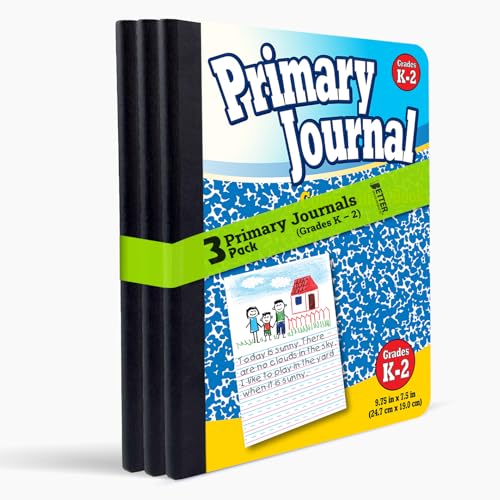
Best for durability and simple storage of writing assignments. This three-pack of hardcover journals uses dotted lines on 100 sheets per book, with a blue marble cover design. Pages are sewn and tape-bound for added strength. The inside cover features printed alphabet and lowercase/uppercase references for quick visual cues. Choose this if you want a sturdy option for daily use. Limitation: hardcover may feel heavier for very young children.
Buying Guide
Key questions to consider when choosing a primary notebook with picture space:
- What page layout best supports my child’s writing progress? Consider top drawing space with primary ruled lines below for easy storytelling and handwriting practice.
- How important is the size and weight? The standard 9.75 x 7.5 inch size fits most backpacks and desks, while heavier hardcovers add durability.
- Should I buy in a pack or a single notebook? Packs save money for classrooms or households with multiple students, but a single notebook can suit a focused learner.
- Are there built-in guides such as alphabet references or story-writing prompts? These aids help younger writers form letters and structure sentences.
- Is bleed-through a concern with crayons or pencils? Thicker paper reduces bleed-through for mixed-media drawing and writing.
- What is the preferred age range? Most options target grades K-2; some include Pre-K compatibility for early beginners.
Quick comparison at a glance
- Best for story illustrations with a manuscript alphabet: Mead Primary Journal Creative Story Tablet.
- Better for multiple students or activities: Rosmonde 5 Pack Primary Composition Notebook.
- Choose this for classroom or homeschool bundles: ONAVIA Primary Composition Notebook K-2 (4 Pack).
- Good for supervised storytelling with drawing prompts: C-Line Primary Ruled Notebook.
- Great value for early handwriting with alphabet guidance: Oxford Primary Composition Notebooks (Pack of 4).
- Durable option with a sturdy hardcover: Better Office Products Primary Journal (3 Pack).
FAQ
- Q: What is primary ruling and why is it helpful for beginners?
A: Primary ruling includes a larger bottom line and a dotted midline to guide letter size and placement, which helps new writers form letters more consistently. - Q: Should I choose a notebook with top drawing space or bottom drawing space?
A: Top drawing space is common for younger kids who like to illustrate first, while bottom drawing space may suit those who prefer to draft words first and add pictures later. - Q: Are these notebooks suitable for crayons and pencils?
A: Yes, most notebooks use thicker, higher-quality paper that resists bleed-through with pencils and light crayons; some packs emphasize this in their features. - Q: How many pages should I expect per notebook?
A: Most options provide 100 sheets (200 pages) per notebook, with some bundles offering multiple books for groups or classrooms. - Q: Is an alphabet reference on the cover or inside useful for new writers?
A: An alphabet reference supports letter formation and quick reminders, especially for early learners who are just starting handwriting routines. - Q: Can these notebooks be used for homeschooling only?
A: Many are suitable for both classroom use and homeschooling, offering flexible layouts for daily writing practice.