Building a strong vocabulary in children supports reading comprehension, writing clarity, and overall academic success. The following hand-picked vocabulary books are designed for kids at various grade levels, combining engaging activities with proven strategies. Each pick focuses on meaningful word work, contextual learning, and reproducible practice to fit classroom or homeschool use.
Summary of selected products:
| Product | Brand | Grade Range | Why It Stands Out |
|---|---|---|---|
| 240 Vocabulary Words Kids Need to Know, Grade 4 | Scholastic | Grade 4 | Ready-to-reproduce packets with research-based activities that connect new words to prior knowledge. |
| 240 Vocabulary Words Kids Need to Know, Grade 2 | Scholastic | Grade 2 | Early-grade word building packets that scaffold meaning through context. |
| Daily Word Ladders | Scholastic | Grades 4-6 | Engaging word-building games that reinforce reading, spelling, and phonics. |
| Spectrum Grade 4 Vocabulary Workbook | Spectrum | Grade 4 | Structured practice on word relationships, context clues, roots/affixes, and sensory language. |
| Spectrum 5th Grade Vocabulary Workbooks | Spectrum | Grade 5 | Comprehensive 5th-grade focus with context clues, analogies, and domain-specific terms. |
240 Vocabulary Words Kids Need to Know, Grade 4

This Scholastic title provides 24 ready-to-reproduce packets designed to make vocabulary learning engaging and measurable. The format supports classroom use or independent study, and the activities are built to present skills within meaningful contexts that build on prior knowledge for deeper understanding.
Key features include clearly connected activities that progress from foundational to more complex word usage, and materials that keep students motivated through research-based, interactive tasks. Teachers and parents can leverage these reproducible packets to track progress and tailor instruction to individual learners. The emphasis on contextual understanding helps students see how word choice affects meaning in sentences and passages.
For families seeking structured unit blocks, this volume offers consistency across multiple lessons, reducing prep time while maintaining rigor. The program integrates vocabulary with comprehension and critical thinking, supporting a well-rounded literacy approach for fourth-grade students.
240 Vocabulary Words Kids Need to Know, Grade 2

Scholastic’s Grade 2 edition mirrors the same reproducible structure, facilitating early vocabulary growth through approachable, context-rich activities. The packets are designed to engage younger learners with bite-sized challenges that build confidence and word knowledge in a manageable sequence.
The materials emphasize practical usage and visible progress, helping students connect new words to everyday contexts. By focusing on core vocabulary alongside simple, scaffolded tasks, this resource supports primary-grade readers who are transitioning from phonics to more advanced comprehension. Educators appreciate the predictable format that supports consistent practice and assessment readiness.
With a kid-friendly approach, the Grade 2 book allows for flexible pacing and easy integration into daily routines, whether in small-group instruction or independent stations. The reproducible activities also align well with literacy standards that stress building word recognition and usage through purposeful repetition.
240 Vocabulary Words Kids Need to Know, Grade 6

Targets vocabulary development for upper elementary students, with twenty-four reproducible packets designed to connect new words to prior knowledge and real-world usage. The Grade 6 edition emphasizes context-based learning and conceptual understanding to support advanced reading and writing tasks.
By combining explicit instruction with student-centered activities, this book helps learners deepen word meanings and refine their ability to select precise language. The packet structure supports systematic practice, which is valuable for both classroom rotations and homeschooling plans. The range of words integrates well with literature study, nonfiction reading, and writing projects.
Educators can use this resource to scaffold vocabulary growth across the school year, ensuring students gain robust word knowledge that transfers to comprehension, vocabulary tests, and expressive writing.
Daily Word Ladders: Grades 4-6

Daily Word Ladders blends word-building puzzles with reading, spelling, and phonics practice. Geared toward grades 4–6, this resource uses ladder-style clues that guide students to build and reshape words while climbing toward a final target word.
The interactive format promotes critical thinking and active participation, making vocabulary learning a dynamic activity rather than a passive exercise. The reproducible lessons can be scheduled as daily warm-ups or integrated into more extensive literacy stations. Students gain confidence as they progress through progressively challenging ladders, reinforcing phonemic awareness and word form skills.
Because the activities are game-like yet educationally solid, teachers and parents can monitor growth in word recognition, decoding, and spelling accuracy. The structure supports differentiation, allowing you to adjust complexity to match individual learner needs.
Spectrum Grade 4 Vocabulary Workbook
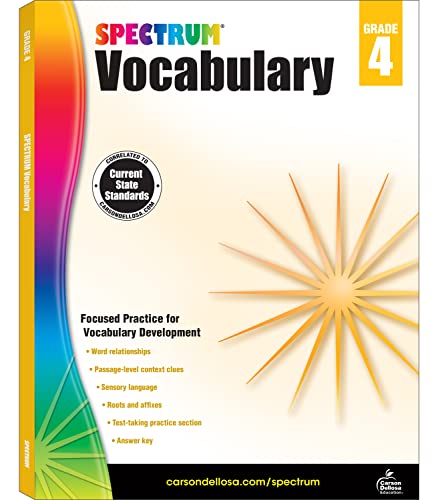
The Spectrum Grade 4 Vocabulary Workbook focuses on essential fourth-grade language skills through a structured approach. It covers word relationships, context clues, sensory language, roots and affixes, and reading comprehension contexts, providing a comprehensive framework for vocabulary development.
Key strengths include clear skill progression, kid-friendly activities, and a balance between explicit instruction and applied practice. The workbook supports both classroom learning and homeschool settings, with content designed to align with common core guidelines and grade-level expectations. Students build a usable vocabulary toolkit that translates into more precise reading and writing.
Educators will appreciate the targeted focus on word meaning, usage, and morphology, which helps students unlock complex texts and improve their ability to infer meaning from context. Parents can also use it as a supplemental resource to reinforce daily vocabulary work at home.
Spectrum 5th Grade Vocabulary Workbooks

This Spectrum edition targets fifth-grade vocabulary with a broad scope that includes context clues, analogies, multiple-meaning words, roots and affixes, and domain-specific terms. The workbook format supports steady practice and improvement in reading comprehension and verbal expression.
Strengths include structured lessons with clear objectives and a progression from basic to more advanced vocabulary tasks. The focus on relational word thinking—how words connect, contrast, and expand meaning—helps students build flexible, transferable language skills for writing and discussion. The content is suitable for classroom use or independent study, and it pairs well with novels, nonfiction texts, and core language arts curricula.
Buying Guide: Key Purchase Considerations
- Grade alignment: Select materials matched to your child’s or student’s grade level, but consider options that offer progression to higher levels if growth is the goal.
- Format and accessibility: Reproducible packets, workbooks, and game-style activities cater to different learning styles. Choose formats that fit your teaching approach and time availability.
- Contextual learning: Look for resources that emphasize context clues, word relationships, roots and affixes, and real-world usage—these support durable vocabulary mastery.
- Practice balance: A mix of reading, writing, and word-building activities helps reinforce memory and application, not just rote memorization.
- Assessment potential: Materials with clear progress indicators or reproducible assessment prompts help track growth and adjust instruction.
- Engagement level: Interactive ladders, games, and puzzles can boost motivation, especially for reluctant learners, while preserving educational rigor.
- Compatibility: Consider whether the books align with your existing curriculum standards or literacy goals, and whether you need standalone resources or a long-term program.
- For homeschool: Look for self-contained packs with clear instructions, answer keys, and flexible pacing to accommodate family schedules.
In sum, the highlighted titles provide diverse approaches to vocabulary development—from structured reproducible packets to interactive word ladders and comprehensive workbooks. By combining multiple formats, you can address different learning preferences and build a robust, transferable vocabulary that enhances reading comprehension and expressive writing across subjects.