Choosing the right workbooks for preschoolers supports fine motor skills, early literacy, and number sense without screen time. This guide spotlights five credible options that blend hands-on tracing, shape and color practice, and problem-solving activities. Each pick fosters independent play, classroom readiness, and at-home learning in a compact, durable format.
| Product | Brand |
|---|---|
| Preschool Learning Activities – Tracing Books for Kids Ages 3-5 | Momo & Nashi |
| School Zone Big Preschool Workbook | School Zone |
| Montessori Preschool Busy Book for Toddlers Ages 3 and Up | Momo & Nashi |
| Preschool Big Fun Workbook | Random House Books for Young Readers |
| School Zone Thinking Skills Workbook | School Zone |
Preschool Learning Activities – Tracing Books
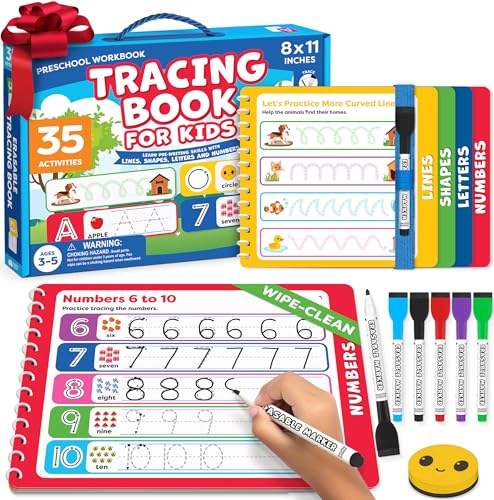
Designed for ages 3-5, this all-in-one dry-erase tracing workbook includes 6 colorful markers, a smiley eraser, a pen holder, and a sturdy storage box. The set encourages independent, device-free creativity while developing fine motor skills and kindergarten readiness. It emphasizes handwriting practice through tracing letters, shapes, lines, and numbers 1-10, promoting stroke recognition, color sorting, memory, and coordination. Reusable features support repeated use in homeschool, daycare, or Montessori settings.
School Zone Big Preschool Workbook

This comprehensive 320-page workbook targets early writing, alphabet basics, phonics, basic math, colors, shapes, and matching. It emphasizes handwriting to strengthen memory and creative thinking, with a broad range of exercises designed to prepare children for school success. The material blends colorful activities with structured practice, aiming to build confidence and foundational skills across literacy and numeracy.
Montessori Preschool Busy Book for Toddlers

This fully preassembled busy book offers 14 educational themes—from letters and numbers to emotions and weather—designed for travel, quiet time, and busy hands. It supports independent learning with activities that strengthen memory, problem-solving, and hand-eye coordination. The screen-free format makes it a versatile gift option for 3-year-olds, suitable for both boys and girls, and adaptable to various learning environments.
Preschool Big Fun Workbook

This 256-page workbook delivers a mix of preschool math, writing practice, shapes, puzzles, and basic literacy activities. It provides a broad spectrum of paper-based activities that support early numeracy and writing readiness, with a balance of engaging visuals and straightforward tasks designed for daily practice and progression.
School Zone Thinking Skills Workbook

Structured to nurture problem-solving, logic, and reasoning, this 64-page workbook is part of the Get Ready! series for ages 3 to 5. It stresses critical thinking through fun, age-appropriate activities that align with early learning standards. The workbook format supports guided practice and independent exploration, ideal for classroom and home settings alike.
Buying Guide: Key Purchase Considerations
- Age and readiness alignment: Choose materials labeled for ages 3-5 or specifically for 3-year-olds to ensure appropriate difficulty and pacing.
- Skill emphasis: Look for a balance of handwriting practice, early math, shapes, colors, and basic literacy to cover multiple domains.
- Format and durability: Dry-erase or reusable formats reduce waste and extend use; sturdy binding helps with frequent handling by small hands.
- Screen-free learning: Favor products that promote hands-on interaction, memory, and fine motor development without digital devices.
- Portability and storage: Compact, organized sets (like boxed bundles or binders) are convenient for travel and daily routines.
- Teacher and caregiver notes: Clear instructions and progression cues help adults guide practice effectively.
- Quality and safety: Non-toxic materials and child-safe inks are important for ongoing use by young children.
- Value and long-term use: Reusable components (erasable markers, wipeable pages) can justify higher upfront costs.
- Learning style compatibility: Some children prefer tracing and handwriting, others may benefit from game-like activities or Montessori-inspired tasks.
These selections provide a spectrum of approaches—from the interactive busy-book model to traditional workbook formats—allowing caregivers to tailor choices to a child’s interests and developmental needs. Each option supports early literacy, numeracy, and motor skills while offering duration-friendly usage for home or classroom environments.